Don't fall for this - how to protect yourself from AI scams
Published
What's this about?
Trading standards officers say AI is "super-charging" existing scams through clones and fake websites.
The one-panel cartoon

Read the cartoon's script
A dimly lit, cluttered office room with multiple computer monitors displaying identical fake websites and AI voices mimicking real customer service agents on speakers, with a stack of printed scripts and a list of targets on a clipboard.
Caption: Scammers are now outsourcing their voices to AI
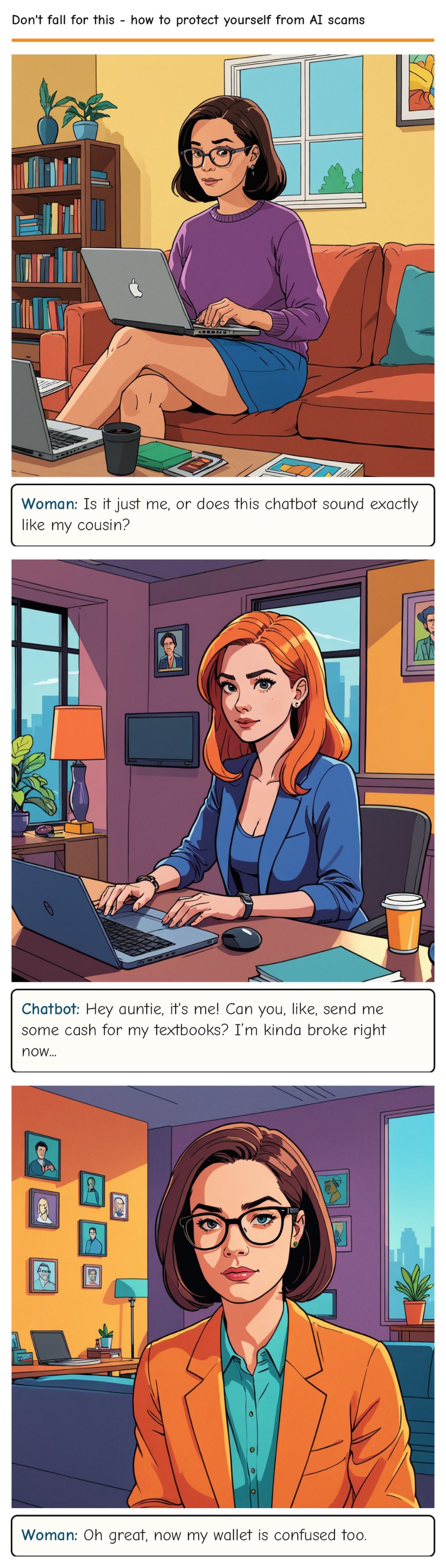
Read the full 3-panel strip
Based on the original story on bbc.co.uk.
Editor's note
As AI technology advances, it becomes an increasingly potent tool for scammers, amplifying the reach and sophistication of their operations. It's crucial for individuals to stay vigilant and informed, recognizing that traditional safeguards may now be insufficient against these new, AI-driven threats.
Rate this comic
Read the script
Panel 1
A cozy living room, evening. The room is filled with books, a laptop on the coffee table, and a small potted plant on the side. A middle-aged woman, wearing glasses and a casual sweater, is sitting on the couch with a puzzled expression, staring at her laptop screen.
Woman: Is it just me, or does this chatbot sound exactly like my cousin?
Panel 2
The same living room, slightly zoomed in on the laptop screen. The chatbot on the screen looks like a generic avatar, but it's typing out text that mimics the woman’s cousin's mannerisms and slang.
Chatbot: Hey auntie, it's me! Can you, like, send me some cash for my textbooks? I’m kinda broke right now...
Panel 3
The living room, now with the woman's face in a close-up. She looks bewildered, her glasses slipping down her nose. The chatbot message is still visible on the screen behind her.
Woman: Oh great, now my wallet is confused too.
Comments