How new US chip restrictions on South East Asia will hit China
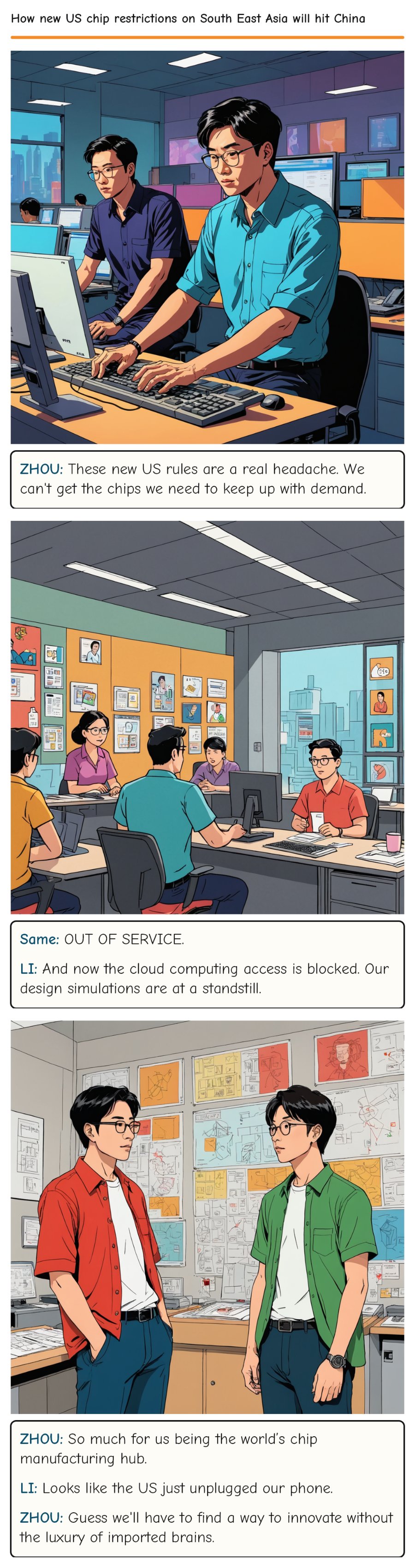
The new rules restrict chip exports and also access to their computing power, which China relies on heavily.
These new restrictions are a double-edged sword, potentially undermining China's technological autonomy while also creating unintended disruptions in global supply chains that rely on Southeast Asian semiconductor manufacturing. While aimed at curtailing China's advancements, the ripple effects may inadvertently burden allied economies that are integral to the global tech ecosystem.
Rate this comic
Script
Panel 1
A high-tech office in Shenzhen, China. A stressed-looking engineer, ZHOU, is hunched over a computer, while a manager, LI, looks over his shoulder, hands clasped behind his back.
ZHOU: These new US rules are a real headache. We can't get the chips we need to keep up with demand.
Panel 2
Same office, but now a large, empty server rack is visible on the far wall, with a sign that reads
Same: OUT OF SERVICE.
LI: And now the cloud computing access is blocked. Our design simulations are at a standstill.
Panel 3
ZHOU and LI look at each other, exasperated. On the wall behind them, a poster showing a flowchart of chip design and manufacturing processes is framed. A red X is drawn over a critical step. LI (dryly) ZHOU (deadpan)
ZHOU: So much for us being the world’s chip manufacturing hub.
LI: Looks like the US just unplugged our phone.
ZHOU: Guess we'll have to find a way to innovate without the luxury of imported brains.
Comments