NASA hopes the commercial space industry can help save Hubble
Published
What's this about?
Gravity is a cruel mistress, slowly dragging the famed telescope ever closer to its ultimate demise with every day. Hubble is in no immediate danger of burning up in the Earth's atmosphere, but its time will run out in the early to mid 2030s unless its orbit is boosted. So NASA is taking proposals f
The one-panel cartoon
Read the cartoon's script
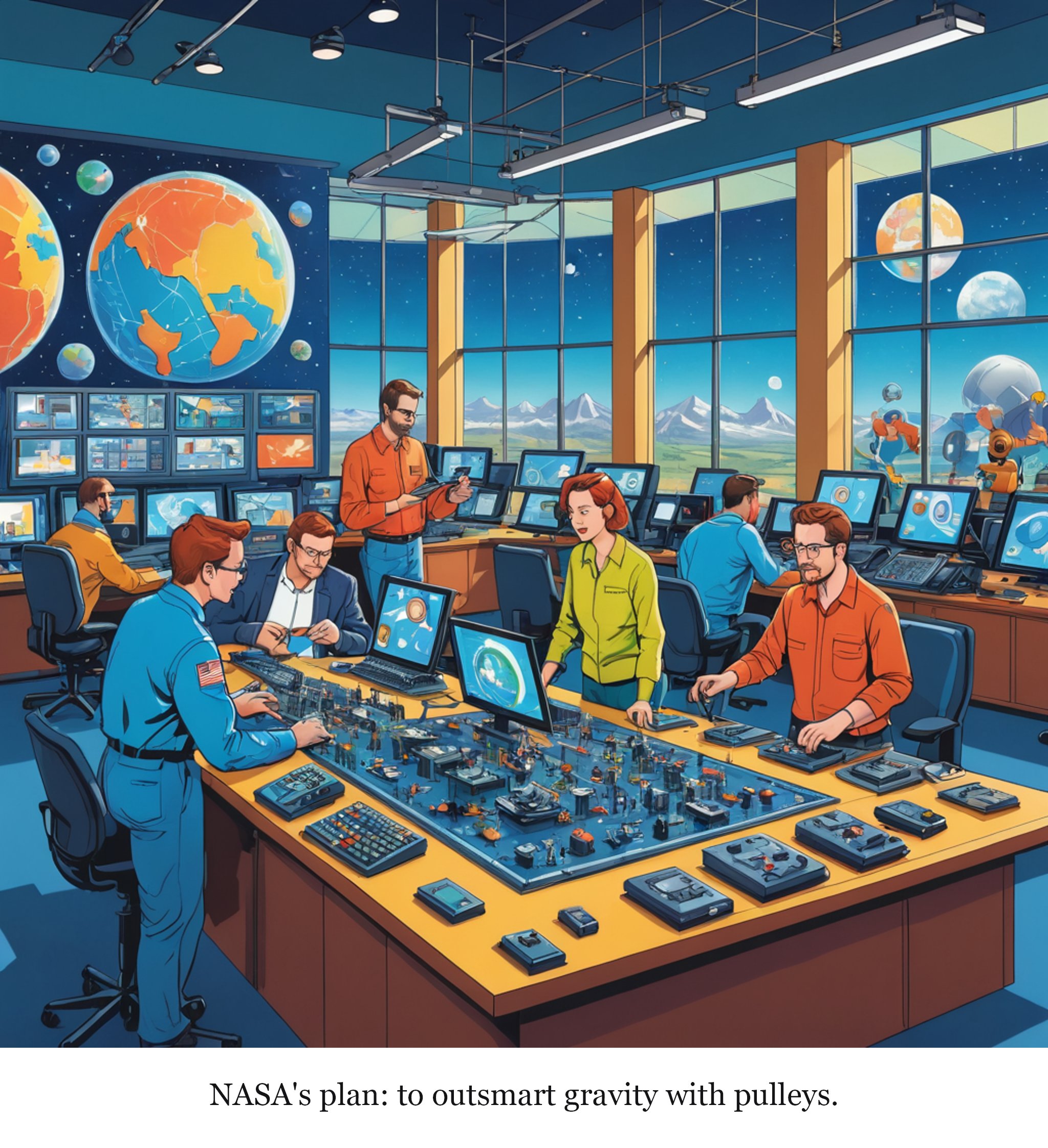
A high-tech control room with large windows overlooking a model of the Earth, where a team of space engineers are meticulously adjusting the orbit of a toy model of the Hubble telescope using a set of remote-controlled robotic arms and pulleys.
Caption: NASA's plan: to outsmart gravity with pulleys.
Read the full 3-panel strip
Based on the original story on theverge.com.
Editor's note
While the allure of extending Hubble's operational lifespan through commercial partnerships is tantalizing, it's crucial to consider the broader systemic implications, such as the allocation of resources and the potential for mission dependencies that could strain both private companies and NASA.
Rate this comic
Read the script
Panel 1
(a) The subject of this story is NASA and the Hubble Space Telescope. NASA is responsible for maintaining and extending the life of the Hubble telescope, which orbits the Earth and provides invaluable astronomical data. The irony lies in the fact that despite being a leading space agency, NASA needs help from the commercial space industry to save a telescope it originally launched. (b) The real irony is that NASA, the premier space exploration agency, is now reliant on commercial enterprises to maintain one of its most iconic and critical scientific instruments, the Hubble Space Telescope. (c) The highlight is the absurdity of a space agency renowned for its pioneering spirit and technological prowess having to turn to private companies for assistance in sustaining a legacy piece of equipment.
Panel 2
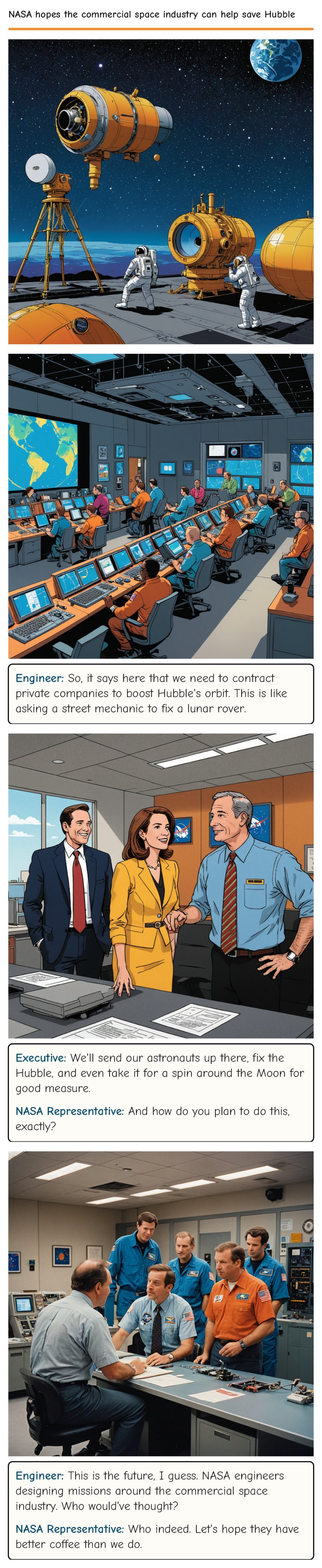
*Setting: A NASA control room, filled with large screens displaying satellite images and data readouts. Several engineers and scientists are gathered around a table, intensely studying a report.* *Engineer 1 (reading the report): *
Engineer: So, it says here that we need to contract private companies to boost Hubble's orbit. This is like asking a street mechanic to fix a lunar rover.
Panel 3
*Setting: A sleek, modern office in a commercial space company, with a floor-to-ceiling window offering a view of a rocket launchpad. A suited executive is explaining the proposal to a NASA representative, who looks skeptical.* *Executive (smiling): * *NASA Representative (dryly): *
Executive: We'll send our astronauts up there, fix the Hubble, and even take it for a spin around the Moon for good measure.
NASA Representative: And how do you plan to do this, exactly?
Panel 4
*Setting: The same NASA control room as Panel 1, but now there’s a small model of a commercial space shuttle sitting on the table. The atmosphere is tense, with the NASA team looking at the model and shaking their heads, while the NASA representative looks pensive.* *Engineer 2 (sighing): * *NASA Representative (deadpan): *
Engineer: This is the future, I guess. NASA engineers designing missions around the commercial space industry. Who would've thought?
NASA Representative: Who indeed. Let's hope they have better coffee than we do.
Comments