Ofcom outlines age check methods ahead of social media ban for under-16s
Published
What's this about?
Ofcom says photo and digital ID, banking checks or facial age estimation can help prove someone is 16 or over.
The one-panel cartoon
Read the cartoon's script
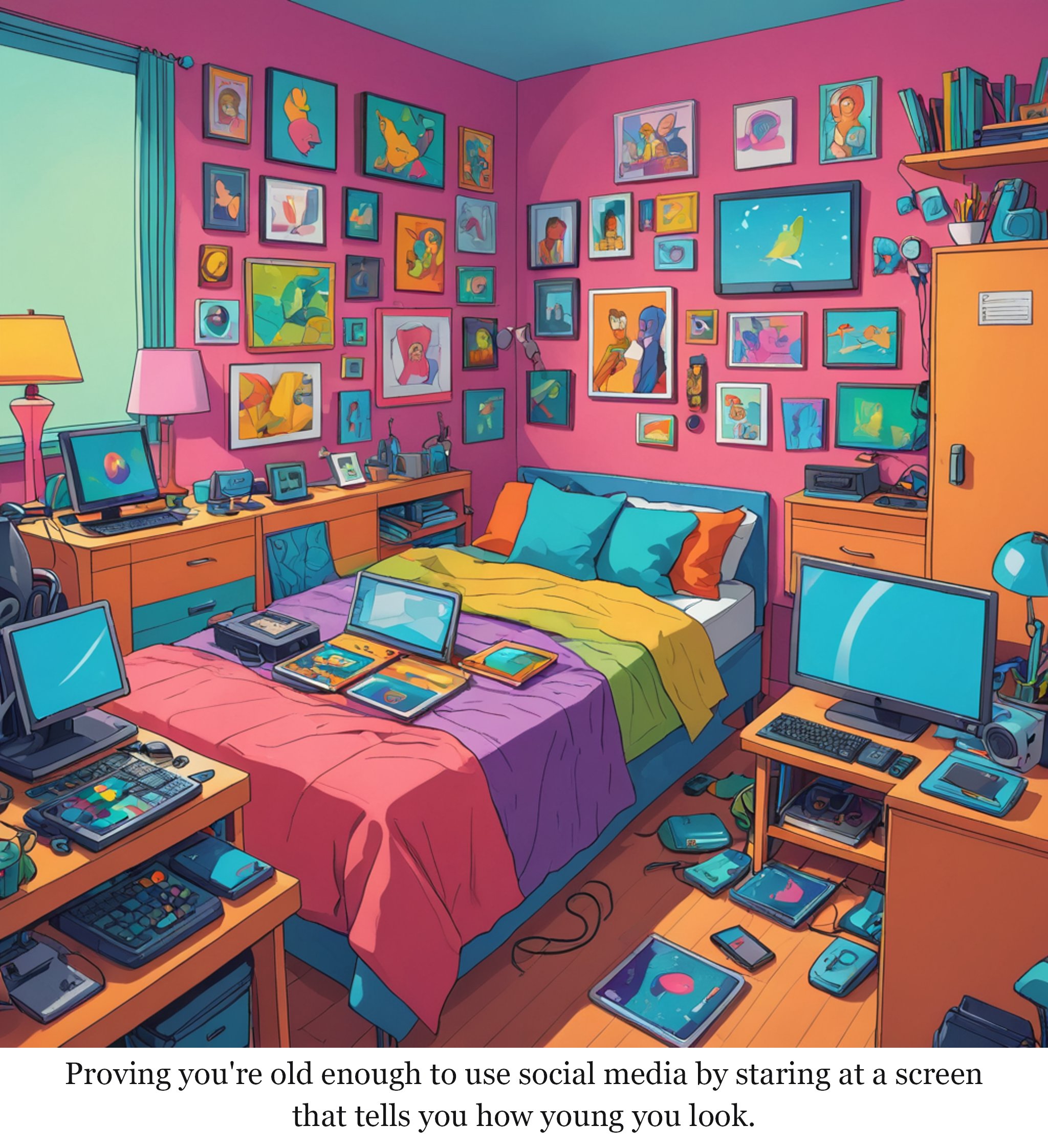
A teenager's bedroom cluttered with tech gadgets, including a smartphone with a social media app that requires age verification through facial recognition software.
Caption: Proving you're old enough to use social media by staring at a screen that tells you how young you look.
Read the full 3-panel strip

Based on the original story on bbc.co.uk.
Editor's note
As social media platforms grapple with age verification, the methods proposed by Ofcom highlight the tension between user convenience and robust security. While facial recognition and digital ID checks offer streamlined solutions, they also raise important questions about privacy and the user experience, emphasizing the need for thoughtful, user-centric design in these crucial checks.
Rate this comic
Read the script
Panel 1
(a) What the subject of this story actually is and does: Ofcom is the regulatory body for broadcasting and telecommunications in the UK. They are tasked with ensuring that communications services are run fairly and efficiently, and now they are proposing a method to enforce age restrictions on social media for under-16s. (b) The ONE real irony or absurdity in the news: The idea that a government body is proposing to use photo and digital ID checks, banking information, and facial recognition technology to verify a user's age before they can access social media seems overly bureaucratic and intrusive, especially for a medium that's meant to be free and accessible. (c) The single funniest observation that becomes the highlight: The absurdity of using advanced technology to enforce a rule that's designed to protect minors, while also creating an obstacle for legitimate users who simply want to engage in social media. ---
Panel 2
*A living room. A teenager, JESSICA, sits on a couch, scrolling through her smartphone. Her parents, PAUL and LUCY, are seated nearby, looking concerned.* Paul (sighing)
Paul: Jessica, did you hear about the new social media rules?
Jessica: Yeah, they’re going to make me verify my age with my passport and my bank statement?
Lucy: It’s to protect you, sweetie. But it’s quite a hassle.
Panel 3
*Jessica rolls her eyes and puts her phone down. Lucy and Paul look at each other, frustrated.*
Jessica: It’s just another way to make social media harder to use. I have to prove I’m old enough to be online?
Paul: Ofcom says it’s necessary to keep platforms safe for everyone. But it’s pretty ridiculous.
Lucy: And now we have to worry about your digital identity being safe from all this.
Panel 4
*Jessica stands up, holding her phone and looking at the screen with a bemused expression. The living room is cluttered with books and gadgets, indicating a tech-savvy household.* Jessica (dryly) Paul (shaking head)
Jessica: So, to log in, I just need to upload a selfie and let a computer decide if I look old enough. Great.
Paul: This is exactly why we need better solutions, not just more bureaucracy.
Lucy: It’s like we’re living in a dystopian future where technology is supposed to protect us from itself.
Comments