OpenAI announces three big science discoveries and a new way to work with academics
Published
What's this about?
Less than a month after its mass release of hundreds of manuscripts that it said contained solutions to long-standing mathematics questions, OpenAI is back with three more "major" discoveries in math, computer science, and physics. What's different this time is the choice to have external experts th
The one-panel cartoon
Read the cartoon's script
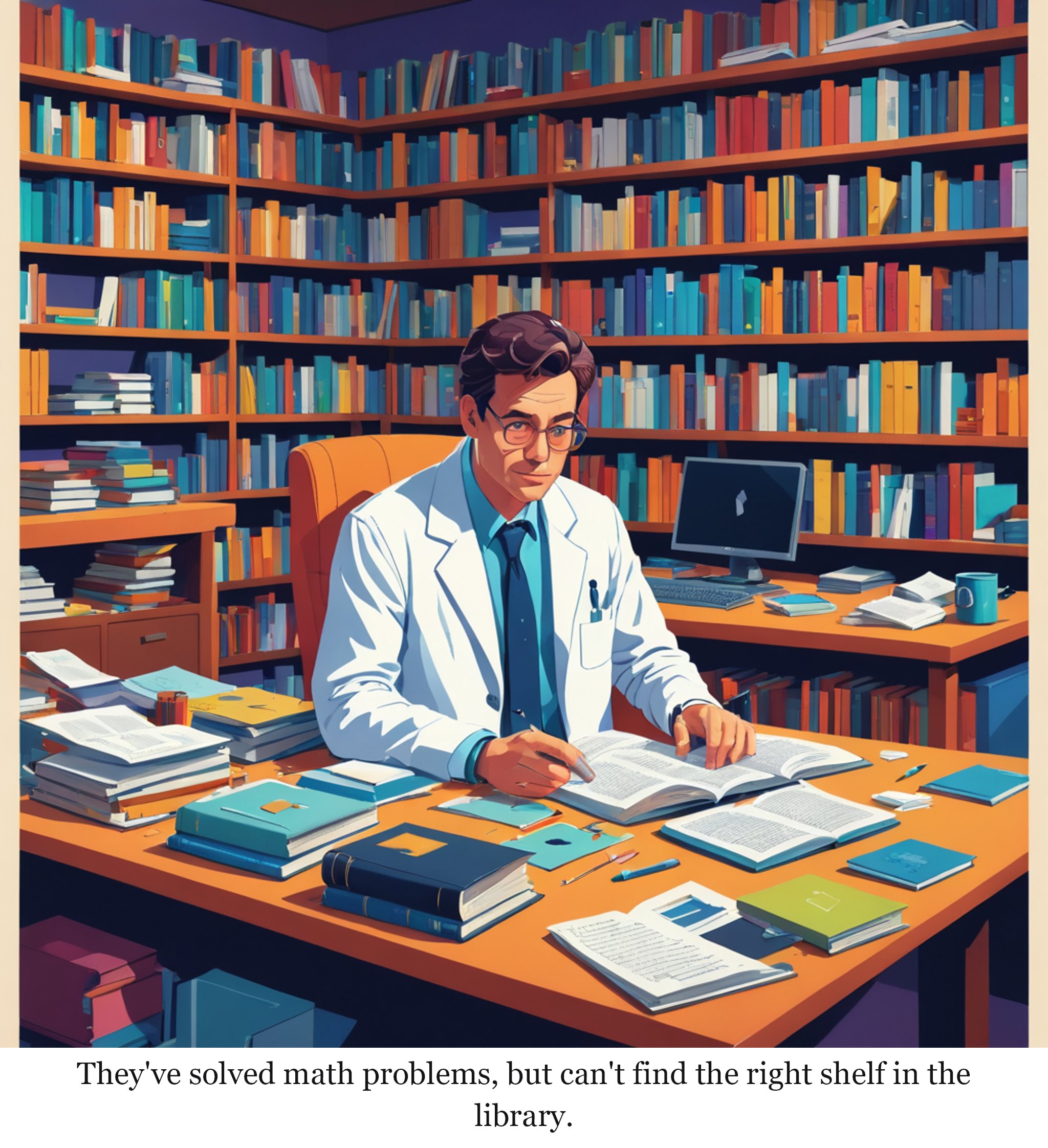
A dimly lit, cluttered academic library with bookshelves lined with dusty tomes, a solitary figure in a lab coat hunched over a table strewn with notes and a crumpled copy of the latest scientific journal, reading an article titled 'OpenAI’s Latest Mathematical Discoveries,' with a puzzled look on their face.
Caption: They've solved math problems, but can't find the right shelf in the library.
Read the full 3-panel strip
Based on the original story on theverge.com.
Editor's note
OpenAI's latest move to involve external experts in validating their scientific breakthroughs is a step in the right direction, but it doesn't mask the broader concern: are these rapid-fire discoveries genuine, or are we witnessing an era of unchecked scientific assertion masquerading as progress?
Rate this comic
Read the script
Panel 1
(a) What the subject of this story actually is and does: OpenAI is a company known for developing and releasing advanced AI technologies and research, including language models and other AI tools. Recently, they have been involved in publishing academic papers with claimed breakthroughs in various scientific fields. (b) The ONE real irony or absurdity in the news: The irony lies in a tech company that is not traditionally known for scientific research claiming major discoveries in mathematics, computer science, and physics, and now inviting external experts to validate these findings. (c) The single funniest observation that becomes the highlight: OpenAI’s move to involve external experts seems more like an admission of needing validation from the scientific community, rather than a genuine collaborative effort. ---
Panel 2
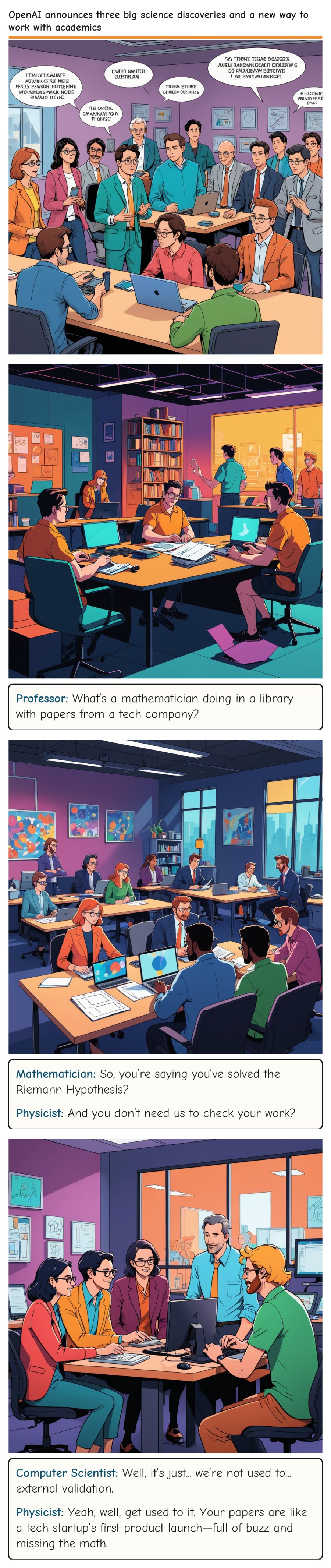
*Setting: A university library, with rows of books and students studying. A professor is sitting at a table with a pile of OpenAI research papers.* Professor (to himself, shaking his head)
Professor: What’s a mathematician doing in a library with papers from a tech company?
Panel 3
*Setting: A conference room at OpenAI headquarters. Several scientists and mathematicians sit around a table filled with papers and laptops, looking skeptical.*
Mathematician: So, you’re saying you’ve solved the Riemann Hypothesis?
Physicist: And you don’t need us to check your work?
Panel 4
*Setting: The same conference room. The scientists and mathematicians are now looking at each other, sharing a bemused laugh. The OpenAI representative looks slightly uncomfortable.* Physicist (smiling)
Computer Scientist: Well, it’s just... we’re not used to... external validation.
Physicist: Yeah, well, get used to it. Your papers are like a tech startup’s first product launch—full of buzz and missing the math.
Comments