Researchers are getting tired of OpenAI gatekeeping its breakthroughs
Published
What's this about?
On Monday, OpenAI announced impressive breakthroughs in mathematics, computer science, and physics, along with what the company says is an evolving approach to communicating its findings. But despite its apparent course correction, researchers who spoke to The Verge are growing increasingly tired of
The one-panel cartoon
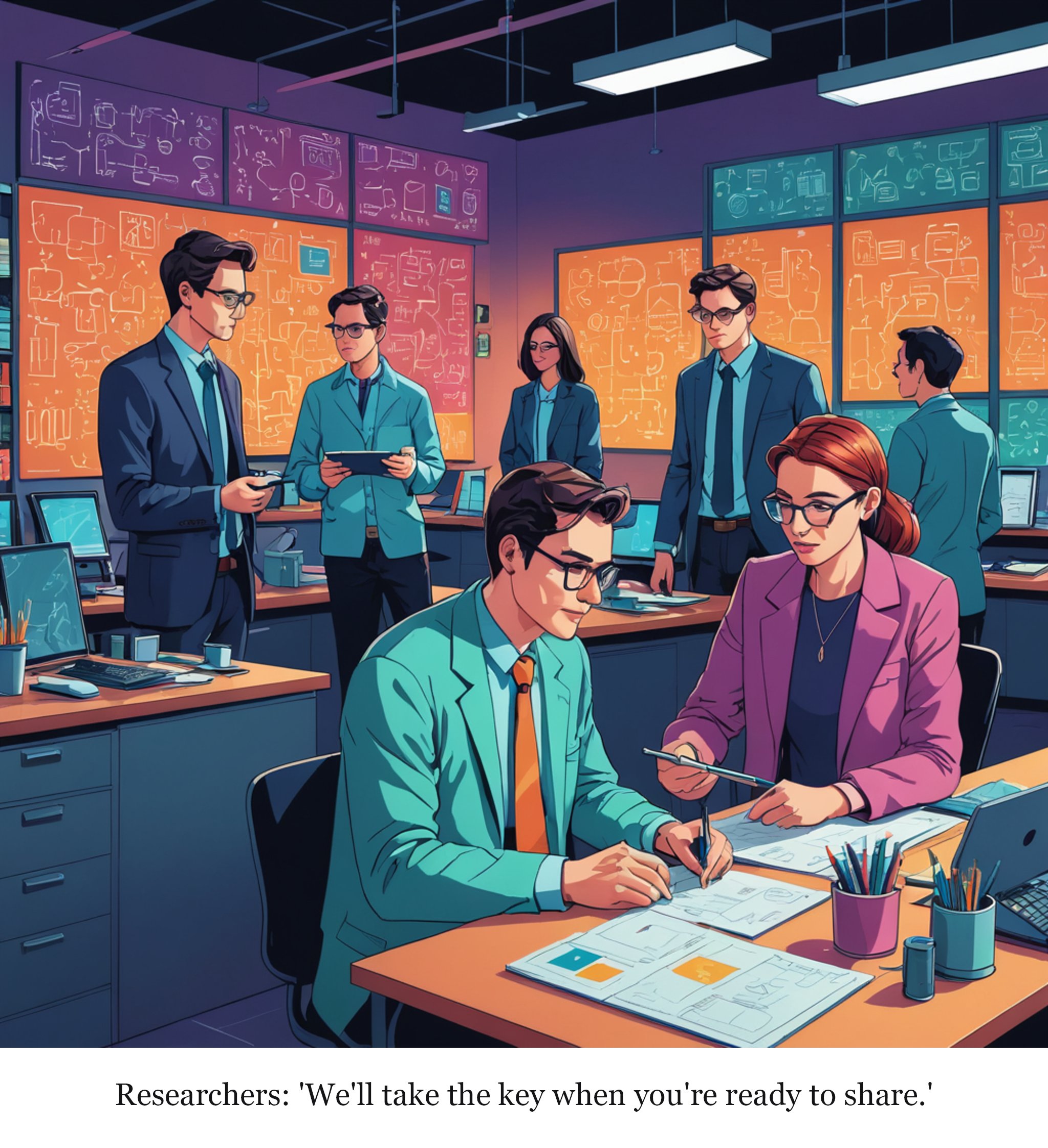
Read the cartoon's script
A dimly lit university lab with chalkboards covered in complex equations and formulas. Several scientists are intensely studying and discussing, but one researcher is holding a 'Key to Knowledge' padlock over a locked file cabinet labeled 'OpenAI Research,' looking exasperated.
Caption: Researchers: 'We'll take the key when you're ready to share.'
Read the full 3-panel strip

Based on the original story on theverge.com.
Editor's note
As OpenAI shares its latest breakthroughs, it's essential to consider whether the current gatekeeping practices truly serve the broader scientific community or merely reinforce barriers that hinder collaboration and progress. Researchers deserve access to innovative tools and findings to drive discovery and innovation, and it's crucial that OpenAI's policies do not inadvertently leave them behind.
Rate this comic
Read the script
Panel 1
(a) What the subject is and does: OpenAI is a research laboratory that develops advanced AI technologies and conducts groundbreaking research in fields like mathematics, computer science, and physics. OpenAI is known for its secretive nature and selective sharing of its research findings, often gatekeeping information that could benefit the wider scientific community. (b) The real irony or absurdity: Despite OpenAI’s recent announcement of an evolving approach to sharing its research, the reality is that many researchers still feel frustrated and left out due to the company's continued restrictive practices. (c) The funniest observation: The highlight is that despite OpenAI’s stated intentions to be more open, the researchers who need the information are still being told to wait their turn, mirroring the absurdity of a gatekeeper who says they will open the gate but keeps it locked. ---
Panel 2
*Setting: A university lab with chalkboards filled with equations and a team of researchers gathered around a large monitor showing an OpenAI livestream.* *Researcher 1 (typing)*: *Researcher 2 (skeptical)*: ---
Researcher: I just signed up for the OpenAI newsletter. They say they’re going to share more findings now.
Researcher: Yeah, and I’ve been waiting for a response from them for months.
Panel 3
*Setting: A small, dimly lit office with piles of papers and a computer displaying an OpenAI portal with a message that reads, * *Researcher 1 (frustrated)*: *Researcher 2 (sarcastic)*: ---
Setting: Please wait for your turn.
Researcher: They say they’re being more open, but the portal still says 'Please wait for your turn.
Researcher: Great, we’re still on the waiting list for a glimpse of their breakthroughs.
Panel 4
*Setting: A crowded conference room with a large screen showing an OpenAI presentation. The researchers are gathered around, looking frustrated as the speaker on the screen says, * *Speaker (on screen)*: *Researcher 1 (exasperated)*: *Researcher 2 (deadpan)*:
Setting: We’re committed to transparency...
Speaker: ... but we’re still evaluating the best way to share these findings.
Researcher: Evaluating? Since when did science become a waiting game?
Researcher: Because OpenAI said they’re transparent, but they’re just making us wait in line.
Comments