SpaceX’s ambitious, expensive gamble to replace AT&T, T-Mobile, and Verizon
Published
What's this about?
Today, I’m talking with Walter Piecyk, a partner and analyst at LightShed Partners who covers tech, media, and telecom, about SpaceX’s recently announced plan to become a major wireless carrier. Last week, SpaceX agreed to buy a big chunk of low-band spectrum to expand the Starlink network, spectrum
The one-panel cartoon
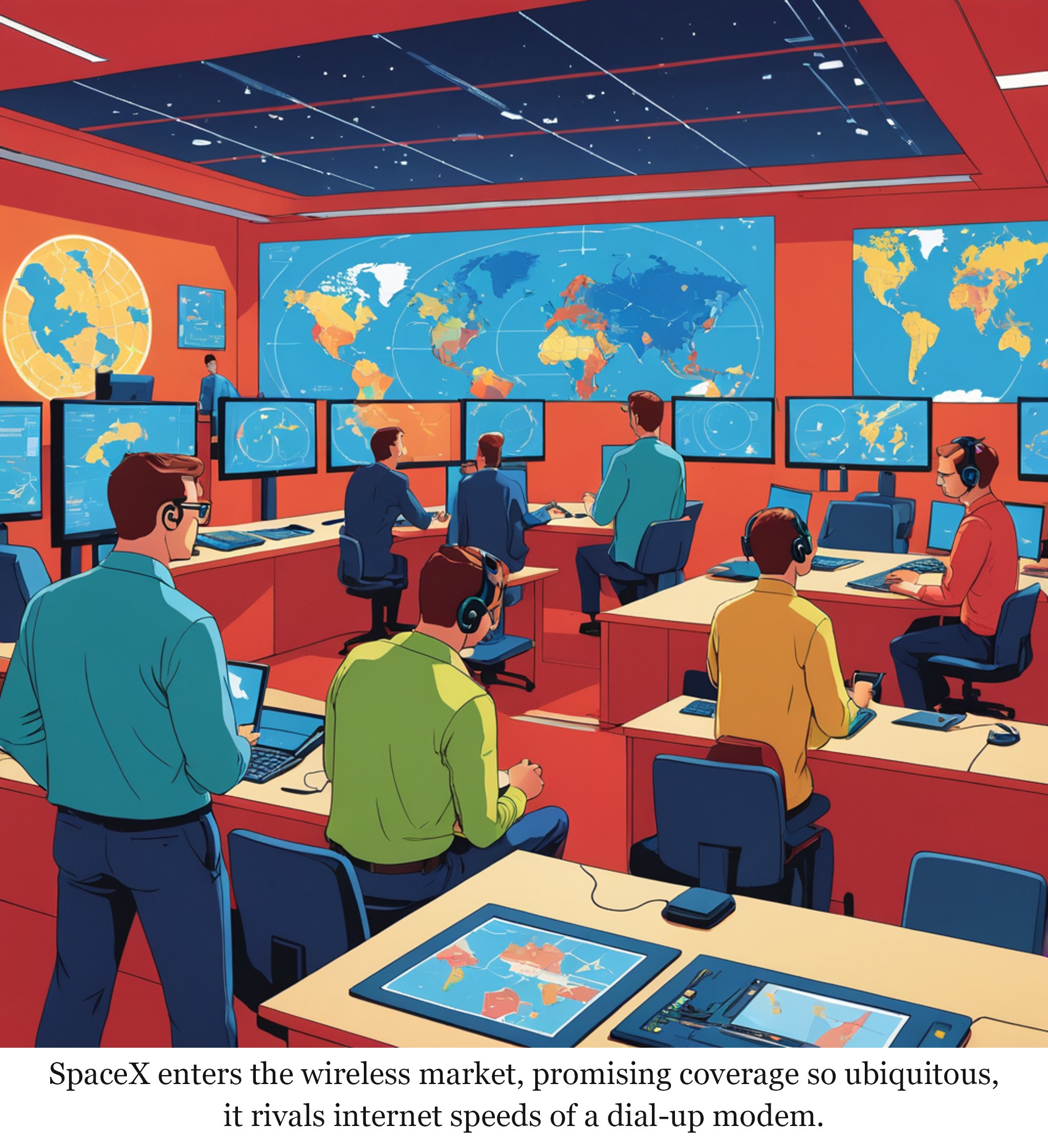
Read the cartoon's script
A high-tech meeting room with satellite dishes on the walls, engineers in headsets, and a large screen displaying a map of global Starlink coverage, with a small corner showing the United States covered in red, indicating network congestion.
Caption: SpaceX enters the wireless market, promising coverage so ubiquitous, it rivals internet speeds of a dial-up modem.
Read the full 3-panel strip

Based on the original story on theverge.com.
Editor's note
SpaceX's move into the wireless carrier market is a bold bet on the economics of satellite-based internet, but the financials are murky at best. With significant upfront costs and uncertain revenue streams, this gamble underscores the company's ambition but raises questions about long-term viability.
Rate this comic
Read the script
Panel 1
(a) What the subject is and does: SpaceX is a space exploration company known for launching rockets and satellites. Their recent venture is expanding into telecommunications by buying low-band spectrum to compete with established wireless carriers like AT&T, T-Mobile, and Verizon. (b) The real irony or absurdity: The irony lies in SpaceX’s ambitious and expensive move to enter a highly competitive and well-established market dominated by telecom giants. The absurdity is the notion of a space company becoming a wireless carrier and competing with telecoms. (c) The single funniest observation: The highlight is the stark contrast between SpaceX’s reputation for space exploration and its new venture in telecommunications. The observation: ---
Narrator: SpaceX is now the only company that wants to connect you to the stars and the internet.
Panel 2
*A conference room at SpaceX headquarters. A large screen displays a satellite image of Earth, and a diagram of a wireless network. Walter Piecyk is sitting at a table with Elon Musk, who is leaning back in his chair, looking contemplative.* ---
Elon Musk: So, Walter, we’ve got plans to take over the wireless market. Any thoughts?
Walter Piecyk: Elon, the telecoms will be wondering how a space company became their biggest competitor.
Panel 3
*An office setting with a desk filled with telecom-related items—phones, tablets, and a model of a satellite. Musk is sitting behind the desk, examining a model of a satellite with a puzzled expression.* ---
Elon Musk: I mean, we’ve been launching satellites for years. Why not use them for something other than space?
Walter Piecyk: It’s like you’re building a rocket to Mars and suddenly decide to use it for pizza delivery.
Panel 4
*A SpaceX control room with multiple screens showing satellite data and a large model of Earth on one screen. The room is filled with tech and space gear. Musk is standing in front of a screen with a chart showing market shares of telecom companies.* Walter Piecyk (smirking) *The screen in the background shows a satellite orbiting Earth, passing over the logos of major telecom companies.*
Elon Musk: We’ll be the only company connecting you to both the stars and the internet. Starlink by day, space by night.
Walter Piecyk: Sounds like you’re aiming for a universal connection. Just make sure you don’t collide with the competition.
Comments