Wikipedia’s operator says a bad AI copyright ruling could threaten the open web
Published
What's this about?
The Wikimedia Foundation is staking out a middle ground in a group of landmark AI copyright cases, pushing courts to legally protect large language models (LLMs) training on copyrighted work - but not chatbots regurgitating that work to users. An overly black-and-white ruling, it says, could either
The one-panel cartoon

Read the cartoon's script
A dimly lit data center with rows of servers labeled 'Wikipedia', 'Encyclopedia', and 'LLMs'. A technician is adding a new sign that reads 'AI Training Grounds - Not a Chatbot Café'.
Caption: We're the bridge, not the bridge too far.
Read the full 3-panel strip
Based on the original story on theverge.com.
Editor's note
The Wikimedia Foundation's stance highlights the delicate balance between protecting intellectual property and fostering the technological innovation that underpins the open web. An overly restrictive ruling could stifle the development and utility of AI, potentially undermining the very principles of information sharing and accessibility that the internet was built upon.
Rate this comic
Read the script
Panel 1
(a) What the subject of this story actually is and does: The Wikimedia Foundation is the nonprofit organization behind Wikipedia and other collaborative knowledge projects. They are advocating for a balanced approach to AI and copyright law, specifically regarding the use of copyrighted material for training AI models versus using AI to directly reproduce that content. (b) The ONE real irony or absurdity in the news: The irony lies in the Wikimedia Foundation’s stance that while AI should be allowed to learn from copyrighted works, it shouldn’t directly reproduce or distribute them. This creates a paradox where AI can read copyrighted books but can’t quote from them. (c) The single funniest observation that becomes the highlight: The highlight is the absurdity of an AI model being able to study Shakespeare but not recite it to a user, despite the user’s request. ---
Panel 2
*Setting: A dimly lit library with bookshelves lining the walls, a desk cluttered with books and papers, and a computer screen displaying a Wikipedia page. An academic-looking person, LEXI, is typing furiously on the keyboard.* LEXI (muttering to herself)
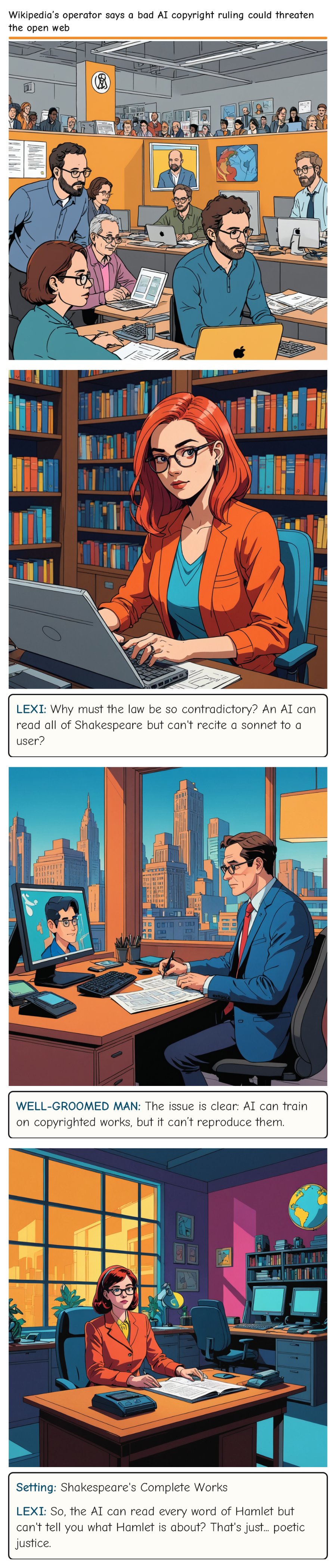
LEXI: Why must the law be so contradictory? An AI can read all of Shakespeare but can't recite a sonnet to a user?
Panel 3
*Setting: A cozy office with a large window overlooking a cityscape. Inside, a WELL-GROOMED MAN with a serious expression is seated at a desk, looking at a legal document on his screen.*
WELL-GROOMED MAN: The issue is clear: AI can train on copyrighted works, but it can’t reproduce them.
Panel 4
*Setting: A dimly lit study with a vintage desk and a globe on a stand. LEXI is now standing, holding a book titled and pointing to the screen with a frustrated expression.*
Setting: Shakespeare's Complete Works
LEXI: So, the AI can read every word of Hamlet but can't tell you what Hamlet is about? That's just... poetic justice.
Comments